In this guide
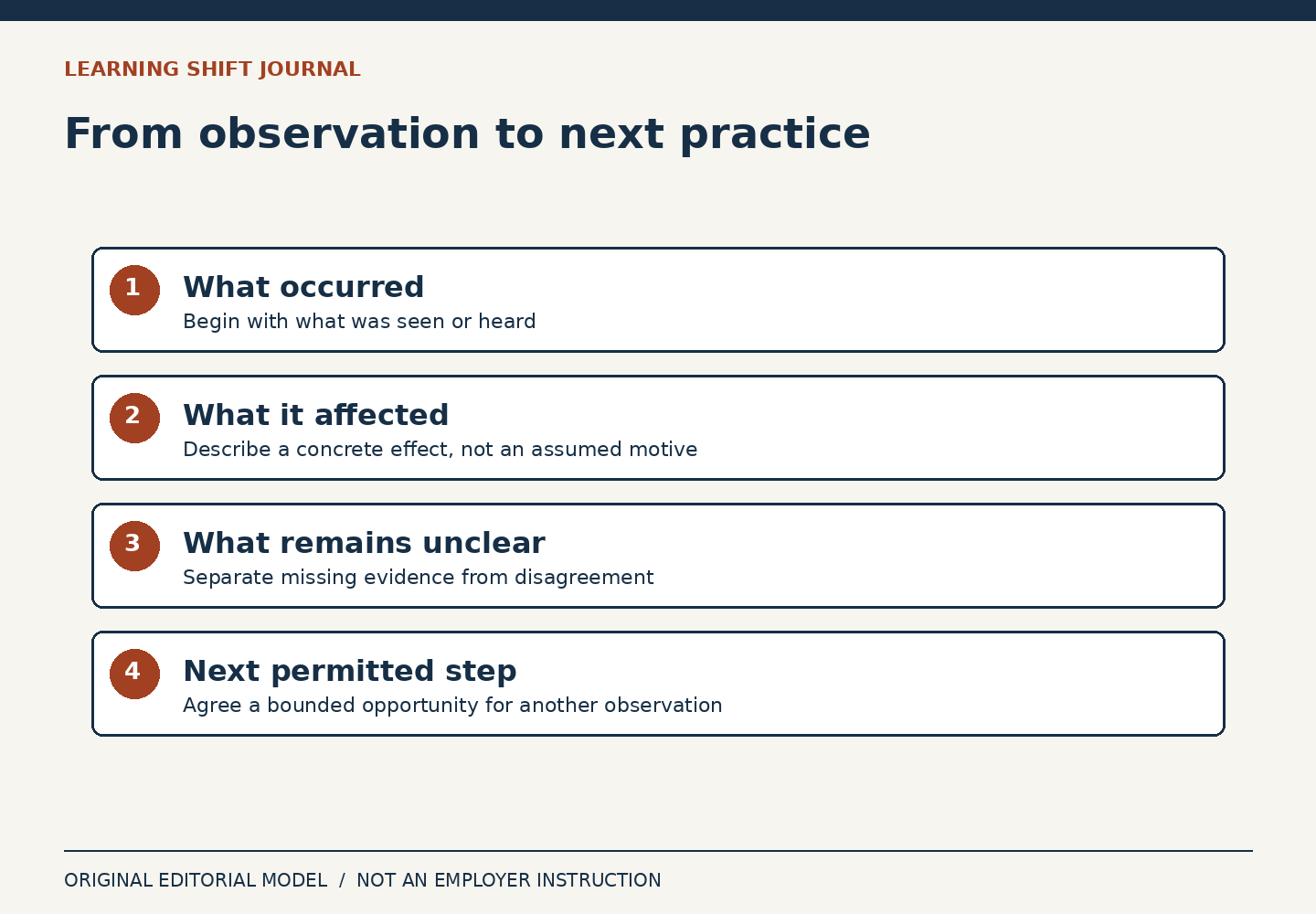
- Make the observation findable Ask about an interaction both people actually observed. “During the fictional handoff exercise, was the remaining question clear?” gives the other person an object to discuss. “Am I a good communicator?” asks them to judge a whole person from incomplete evidence. Keep the request proportionate to what they could know.
- Separate description from interpretation An observation is something like, “The next action was stated after the background.” An interpretation is, “You did not think the next action mattered.” The first can be checked; the second guesses intent. Invite the person to describe what they heard or saw before either of you decides why it happened.
- Ask for an alternative you can actually use A suggestion should fit your authority and resources. “Just change the system” is not an actionable learning step for someone who cannot configure it. “Check the approved directory before giving the floor number” is more concrete, provided that is part of the local process. Clarify which part is the colleague's suggestion and which part is an existing requirement.
- Close with a limited next step Summarize the behavior you will practice, the authorized setting and the person who can observe it. Do not promise a transformation you cannot control. A single follow-up after the next suitable opportunity is often more informative than collecting many disconnected opinions.
- Sources and scope
“How did I do?” is a generous invitation but an imprecise one. A colleague may offer reassurance, a supervisor may think you want a formal rating, and an educator may need more context. A better learning conversation identifies the moment and the kind of help you want. That is especially useful in a large health system where team members meet across different responsibilities and levels of authority.
Northwell's public learning accounts include coaching, mentorship and role-specific development. Those descriptions establish context, not a promise that every team uses one feedback model. The following method is an original editorial aid for an agreed learning conversation. Serious safety concerns, formal performance issues and harassment or discrimination reports need the employer's appropriate processes rather than an informal exercise.
Make the observation findable Ask about an interaction both people actually observed. “During the fictional handoff exercise, was the remaining question clear?” gives the other person an object to discuss. “Am I a good communicator?” asks them to judge a whole person from incomplete evidence. Keep the request proportionate to what they could know.
If the conversation concerns real work, follow workplace rules for discussing it and use only the necessary detail. A public hallway, group chat or personal notebook is not automatically a suitable place. You can ask for time to discuss the communication pattern privately without putting patient or colleague information into the invitation.
Separate description from interpretation An observation is something like, “The next action was stated after the background.” An interpretation is, “You did not think the next action mattered.” The first can be checked; the second guesses intent. Invite the person to describe what they heard or saw before either of you decides why it happened.
In an original nonclinical example, a colleague reports that a direction contained three landmarks before naming the destination. The employee explains that they were trying to be helpful. Both can be true. The learning question is whether the order made the instruction harder to follow, not whether the employee cared enough. A revised rehearsal can test a clearer sequence without rewriting the department's approved information.
Ask for an alternative you can actually use A suggestion should fit your authority and resources. “Just change the system” is not an actionable learning step for someone who cannot configure it. “Check the approved directory before giving the floor number” is more concrete, provided that is part of the local process. Clarify which part is the colleague's suggestion and which part is an existing requirement.
You may disagree with the interpretation. Respond by identifying the evidence you see differently and asking what additional observation would help. You do not need to accept every opinion as a performance fact. Equally, one uncomfortable comment is not a reason to dismiss a useful pattern. Where the matter has formal consequences, ask for the relevant manager or educator to clarify expectations.
Close with a limited next step Summarize the behavior you will practice, the authorized setting and the person who can observe it. Do not promise a transformation you cannot control. A single follow-up after the next suitable opportunity is often more informative than collecting many disconnected opinions.
Write a learning note about the behavior and next question, not a dossier about the person who gave feedback. The goal is to make a skill more deliberate. When the feedback reveals missing instruction or a process conflict, the best next step may be to request clarification rather than to practice harder.
Sources and scope
Public sources checked October 5, 2026. Dated accounts remain historical; examples and planning methods in this article are original editorial constructions.
- Northwell: A 2021 interview on workforce learning
Dated description of CLI enrichment, coaching and development; the title and program menu are historical.
- Northwell: A behavioral health nursing learning journey
Published July 2025 account illustrates role-specific training; details are not instructions for clinical practice.