In this guide
- Match the activity to the evidence If you need to find a term in an approved reference, guided reading may help. If you need to understand a sequence, a demonstration may be useful. If you need feedback on an explanation, a fictional rehearsal can make the words observable. Formal competence may require a specific assessment regardless of your preferred format.
- Notice what a format hides A video can show a process clearly while hiding the questions a learner would ask. A quiz can test recall without showing how someone handles an exception. A conversation can feel clear while leaving no opportunity to practice. These are limitations to discuss, not reasons to dismiss the format.
- Ask for accessibility and practical fit Consider captions, readable materials, keyboard access, language needs and the setting in which you will participate. Ask the training owner for an appropriate alternative when a barrier prevents meaningful participation. Do not alter required content or bypass a completion control to get through the activity.
- Combine formats carefully A short reading followed by a supervised conversation may answer a question better than either alone. But adding activities creates time and coverage needs. Confirm the plan rather than assuming colleagues can supply unpaid or unplanned teaching.
- Sources and scope
An online module is convenient, a live class can invite questions, and a simulation can reveal decisions under a designed set of conditions. None is best for every learning question. The useful comparison starts with the skill, not the format you prefer or the one that is easiest to schedule.
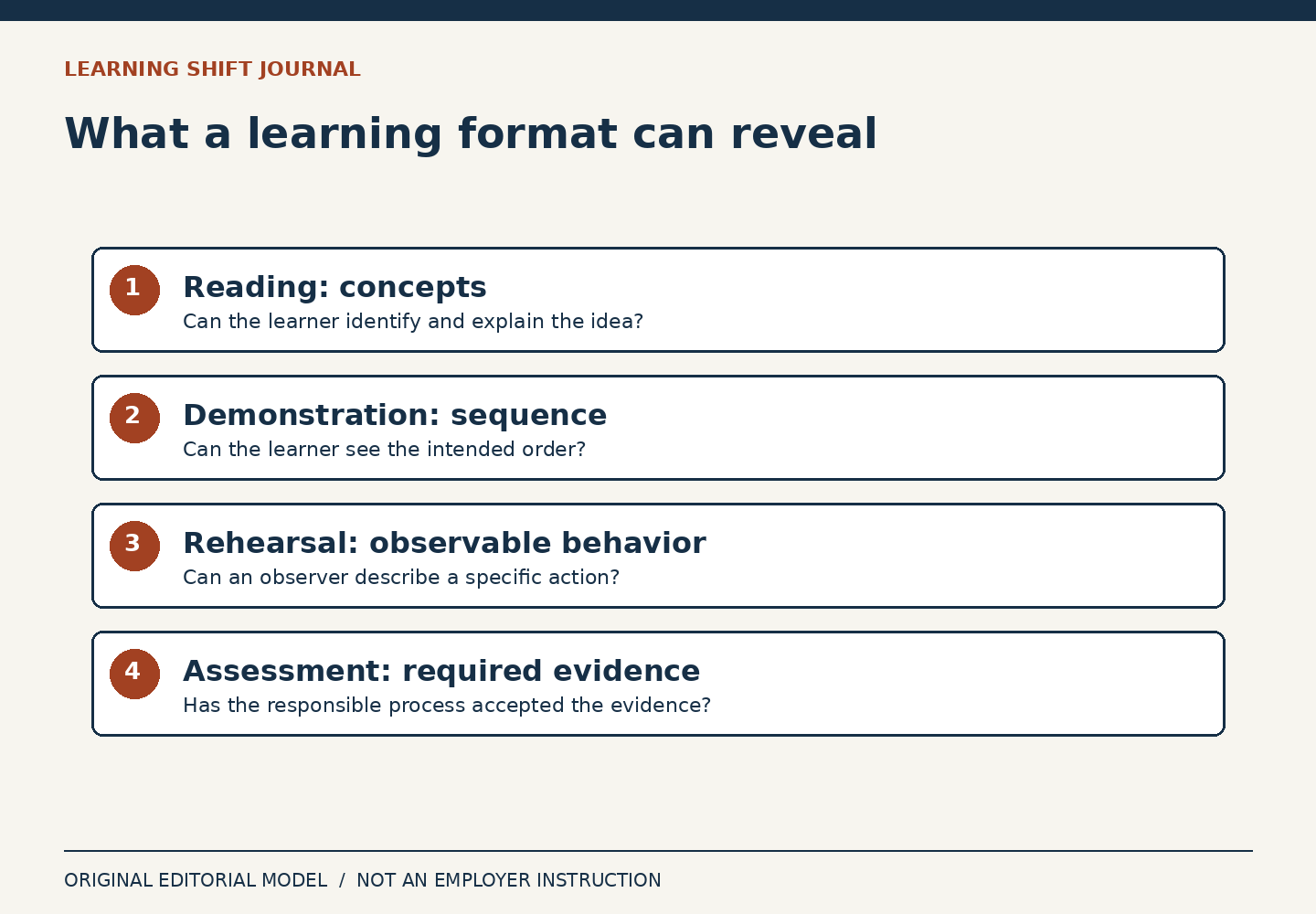
Match the activity to the evidence If you need to find a term in an approved reference, guided reading may help. If you need to understand a sequence, a demonstration may be useful. If you need feedback on an explanation, a fictional rehearsal can make the words observable. Formal competence may require a specific assessment regardless of your preferred format.
Northwell's public CLI description includes several interactive approaches. It does not say that all formats are interchangeable or available for every topic. Ask the educator which activities are appropriate for your role and learning goal.
Notice what a format hides A video can show a process clearly while hiding the questions a learner would ask. A quiz can test recall without showing how someone handles an exception. A conversation can feel clear while leaving no opportunity to practice. These are limitations to discuss, not reasons to dismiss the format.
AHRQ's teach-back learning resources illustrate why an explanation may need a check of understanding. In this publication's nonclinical example, a colleague explains a fictional route and asks the listener to describe the first step. The exercise evaluates the explanation, not the listener's intelligence.
Ask for accessibility and practical fit Consider captions, readable materials, keyboard access, language needs and the setting in which you will participate. Ask the training owner for an appropriate alternative when a barrier prevents meaningful participation. Do not alter required content or bypass a completion control to get through the activity.
The smallest useful accommodation question describes the barrier and the task it affects. Personal medical details should go only through the authorized process when required, not into a casual group discussion.
Combine formats carefully A short reading followed by a supervised conversation may answer a question better than either alone. But adding activities creates time and coverage needs. Confirm the plan rather than assuming colleagues can supply unpaid or unplanned teaching.
Finish by identifying what remains unproven. Completion, confidence and authorization are different outcomes. A learning format can improve understanding while still leaving formal assessment and permission with the responsible organization.
Sources and scope
Public sources checked October 5, 2026. Dated accounts remain historical; examples and planning methods in this article are original editorial constructions.
- Northwell: Developing clinical careers through learning and innovation
Dated 2020 description of CLI and PSI approaches; current enrollment, course availability and clinical permissions are not established.
- AHRQ: Teach-Back learning resources
Public learning resources for checking an explanation; clinical instruction remains within authorized professional practice.