In this guide
- Use four small fields An original learning entry can contain a question, the approved source consulted, a non-identifying observation and the next authorized step. For example: “Question: how should our existing visitor directions identify the destination? Source: current approved desk reference, checked with supervisor. Observation: in a fictional rehearsal, naming the destination first was easier for the observer to follow. Next step: ask whether the wording is appropriate.”
- Keep completion in its proper home An educational completion record may have required fields, a specific system and an official owner. A personal note saying “finished” does not repair a missing completion entry. Conversely, an official completion entry does not show every detail of what you learned. Use each record for its purpose and ask the training owner how discrepancies should be reported.
- Record uncertainty without importing the case It is tempting to preserve a memorable real example because it explains why a lesson mattered. Names are not the only identifiers. A rare event, exact time, unusual role combination or small location can make a person recognizable. Replacing a name with initials may not solve that problem.
- Review for usefulness and accuracy A notebook accumulates assumptions quickly. At a review point, separate current questions from resolved ones and mark sources that need rechecking. Do not retain a superseded local instruction as if it were still applicable. Ask the employer what retention and disposal rules apply to learning materials that belong to work.
- Sources and scope
A learning notebook should help you remember what to ask and practice. It should not quietly become an unofficial patient record, employee file or substitute for an employer's training system. That distinction matters for Northwell staff because learning may happen near sensitive clinical, personnel or operational information even when the skill itself is ordinary communication or organization.
Use only a format and location permitted by your employer. This guide does not authorize personal cloud storage or removal of workplace information. If you do not know what may be recorded, ask before writing. A notebook can remain useful with fictional examples, public references and abstract descriptions of a skill.
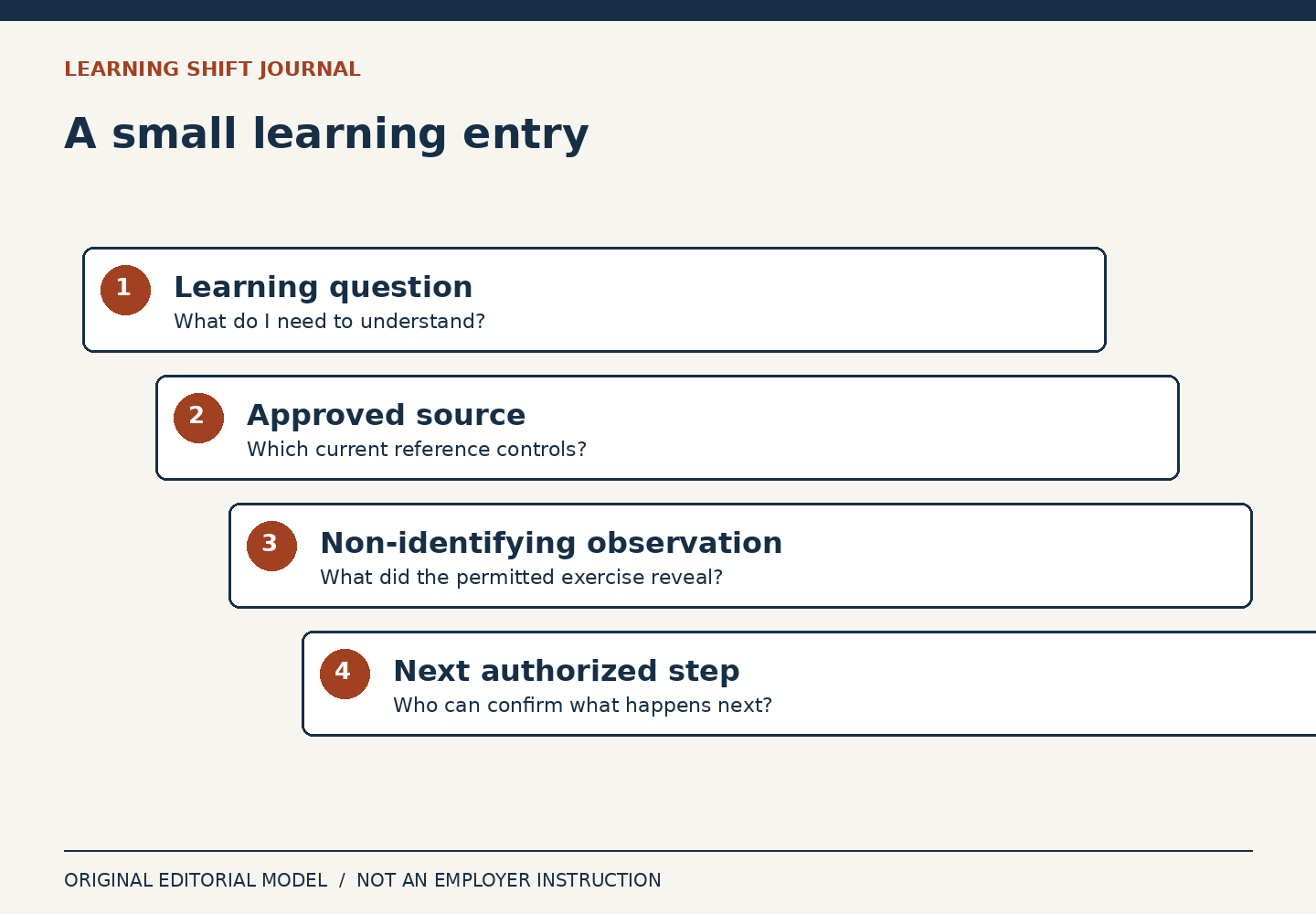
Use four small fields An original learning entry can contain a question, the approved source consulted, a non-identifying observation and the next authorized step. For example: “Question: how should our existing visitor directions identify the destination? Source: current approved desk reference, checked with supervisor. Observation: in a fictional rehearsal, naming the destination first was easier for the observer to follow. Next step: ask whether the wording is appropriate.”
This entry describes learning without storing a visitor's story. It also makes the limits visible. The practice was fictional; the source was local; the outcome was an observation, not a universal finding. If the exact internal reference cannot be copied into a personal note, record only what workplace policy permits or use the designated learning system instead.
Keep completion in its proper home An educational completion record may have required fields, a specific system and an official owner. A personal note saying “finished” does not repair a missing completion entry. Conversely, an official completion entry does not show every detail of what you learned. Use each record for its purpose and ask the training owner how discrepancies should be reported.
Northwell's public CLI account describes ongoing learning approaches, while AHRQ's health-literacy toolkit offers public communication resources. Neither tells you which internal system controls your particular requirement. The authority for the requirement, due date and accepted evidence must come from the current employer or relevant professional body.
Record uncertainty without importing the case It is tempting to preserve a memorable real example because it explains why a lesson mattered. Names are not the only identifiers. A rare event, exact time, unusual role combination or small location can make a person recognizable. Replacing a name with initials may not solve that problem.
Instead, describe the learning pattern at the level needed for the question: “I need to understand who confirms a handoff has been accepted.” Do not copy screenshots, messages, record numbers, medical details or disciplinary information into a private learning collection. If a real event requires reporting, use the authorized reporting route; a notebook is not a report and may leave the responsible team unaware.
Review for usefulness and accuracy A notebook accumulates assumptions quickly. At a review point, separate current questions from resolved ones and mark sources that need rechecking. Do not retain a superseded local instruction as if it were still applicable. Ask the employer what retention and disposal rules apply to learning materials that belong to work.
An effective entry ends with a decision about learning, not a claim about someone else's competence. “Ask the educator to demonstrate the boundary” is specific and modest. “Team X does this wrong” is a broad judgment that the notebook may not support. Keeping the record small protects both its purpose and the people around the learning.
Sources and scope
Public sources checked October 5, 2026. Dated accounts remain historical; examples and planning methods in this article are original editorial constructions.
- Northwell: Developing clinical careers through learning and innovation
Dated 2020 description of CLI and PSI approaches; current enrollment, course availability and clinical permissions are not established.
- AHRQ: Health Literacy Universal Precautions Toolkit
Official toolkit overview reviewed February 2025; used for communication-learning context, not to certify a local workflow.