In this guide
- Choose a behavior small enough to see “Communicate better” cannot be observed reliably. “At the end of an approved routine handoff, state the unresolved question and confirm the receiving person” is more concrete. The behavior should already fit your job, the applicable workflow and your supervisor's expectations. A change to patient care, an access permission, a data collection project or a safety procedure requires the responsible approval before any practice begins.
- Separate three kinds of evidence A completion certificate answers whether the educational requirement was recorded. A practice observation answers whether a behavior occurred in a particular setting. A formal assessment answers whether the employer or professional body has accepted the relevant competence evidence. Do not substitute the first two for the third.
- Put permission before practice The transfer conversation is short: “Here is the idea I took from the learning. Here is the approved task where I think it may help. What can I practice, and who should review it?” That framing gives the manager room to explain a constraint you did not know about. Sometimes the answer will be a simulation, observation or further instruction rather than a live-work attempt.
- Review one result and one limit After the agreed practice opportunity, ask what was clearer, what remained difficult and what the setting prevented you from judging. Avoid turning one successful interaction into a claim about performance across the whole team. A quiet practice room and a busy shift are different conditions.
- Sources and scope
A completed course can leave two very different records: evidence that you attended, and evidence that something became clearer in your work. They are related, but one does not automatically produce the other. A Northwell team member who learns about communication may return to a busy reception desk, laboratory, ward or shared-services office with a useful idea and no obvious place to try it. The missing piece is often a small, authorized transfer plan.
Northwell's current Benefits page places continuing learning within TeamWell's intellectual well-being resources. Its 2020 account of the Center for Learning and Innovation adds historical context about interactive learning; neither page is your current course assignment. This independent guide develops an original planning method around that context. It does not change department procedures, assess competence or give permission to try a clinical technique.
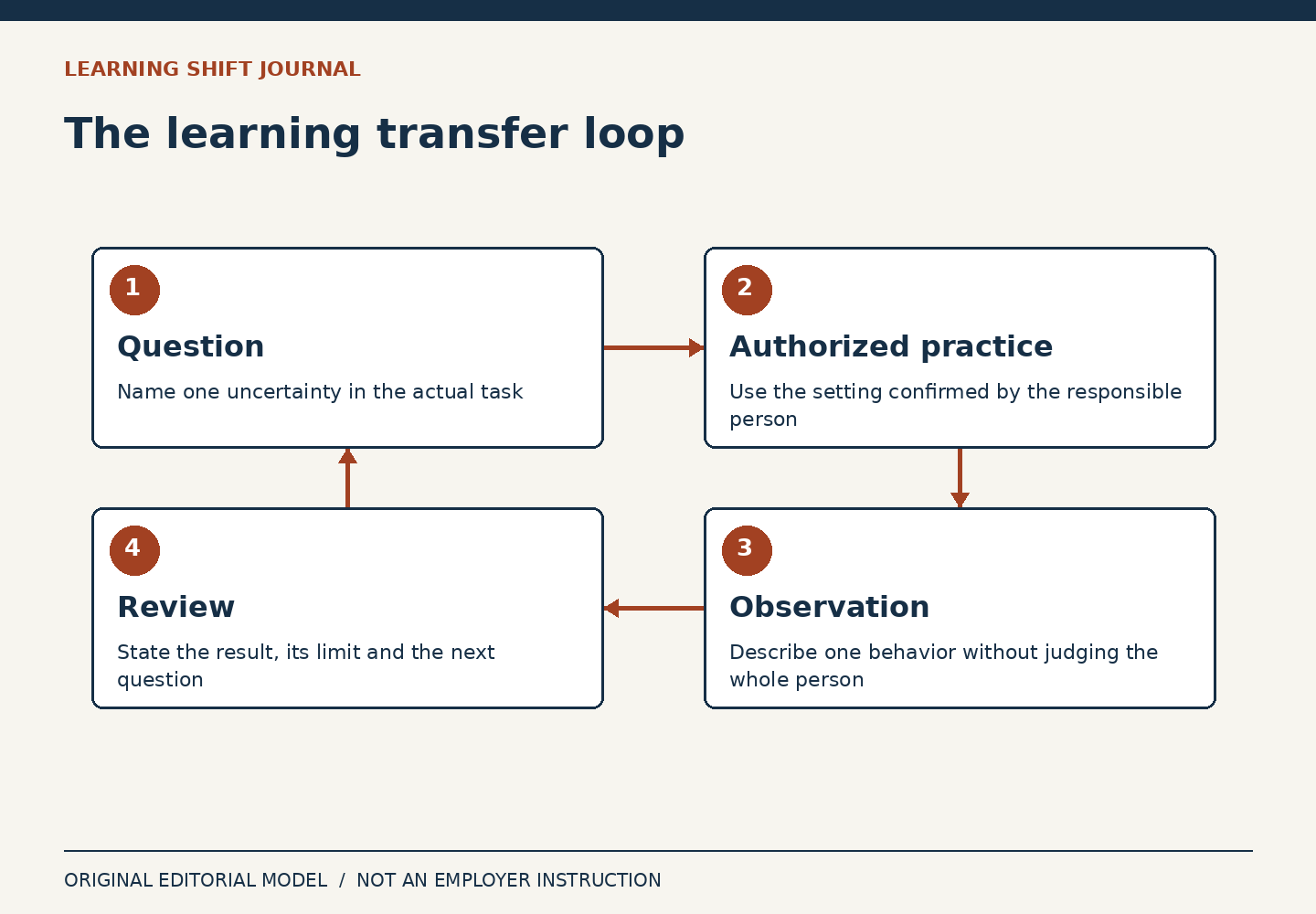
Choose a behavior small enough to see “Communicate better” cannot be observed reliably. “At the end of an approved routine handoff, state the unresolved question and confirm the receiving person” is more concrete. The behavior should already fit your job, the applicable workflow and your supervisor's expectations. A change to patient care, an access permission, a data collection project or a safety procedure requires the responsible approval before any practice begins.
Start with one setting rather than every conversation you have. Describe who is involved by role, what usually happens and where you feel uncertain. Keep patient and colleague identifiers out of a personal learning note. If the learning concerns a protected process, use an employer-approved record and ask what can be written down at all. A useful learning plan can describe the skill without recreating a real case.
Separate three kinds of evidence A completion certificate answers whether the educational requirement was recorded. A practice observation answers whether a behavior occurred in a particular setting. A formal assessment answers whether the employer or professional body has accepted the relevant competence evidence. Do not substitute the first two for the third.
In an original example, a nonclinical team member attends a session on clearer explanations. Their next step is to ask a supervisor whether they can rehearse the existing visitor-direction script with a colleague. Their evidence might be the colleague's observation that the destination and next action were clear. It would not establish that every visitor will understand the route, that the script is officially changed or that the employee is qualified for a different role.
Put permission before practice The transfer conversation is short: “Here is the idea I took from the learning. Here is the approved task where I think it may help. What can I practice, and who should review it?” That framing gives the manager room to explain a constraint you did not know about. Sometimes the answer will be a simulation, observation or further instruction rather than a live-work attempt.
A refusal to change a workflow does not make the course wasted. You can still identify terminology, ask a more precise question or prepare for a supervised demonstration. Keep the outcome honest. “Understood the reason for the current process” is learning; pretending that an unapproved experiment happened is not.
Review one result and one limit After the agreed practice opportunity, ask what was clearer, what remained difficult and what the setting prevented you from judging. Avoid turning one successful interaction into a claim about performance across the whole team. A quiet practice room and a busy shift are different conditions.
Set the next review around an actual opportunity, not a self-imposed promise that learning must be finished in a week. The person responsible for training may require a specific assessment or timeline. Your personal review supports that process; it does not replace it. Use the Learning Experiment Planner on the homepage to make a non-personal question sheet, then take the relevant questions to the authorized educator or supervisor.
Sources and scope
Public sources checked October 5, 2026. Dated accounts remain historical; examples and planning methods in this article are original editorial constructions.
- Northwell: Developing clinical careers through learning and innovation
Dated 2020 description of CLI and PSI approaches; current enrollment, course availability and clinical permissions are not established.
- Northwell: A 2021 interview on workforce learning
Dated description of CLI enrichment, coaching and development; the title and program menu are historical.
- Northwell: Benefits and TeamWell
Current public overview checked October 5, 2026 describes intellectual well-being and learning resources; individual eligibility, scheduling, cost and course availability require current employer confirmation.