In this guide
- Begin with the controlling source Use the employer-approved procedure or reference for the actual task. A public careers page describes types of work, not the local steps for completing it. AHRQ's plain-language resource can help you notice unnecessarily complex wording, but it does not authorize changing the meaning of a workplace instruction.
- Make the stop point visible A good aid does not pretend to cover every exception. It should indicate when to use the designated escalation route: an absent destination, conflicting instructions, a request outside your role or a situation requiring clinical judgment. The escalation information itself must be current and approved.
- Test the reader's path Ask an authorized colleague to use a fictional scenario and describe what they would do first. Do they find the task, the necessary condition and the stopping boundary? Do they mistake an example for a rule? Review the wording before adding more decoration. A large warning cannot compensate for an ambiguous instruction.
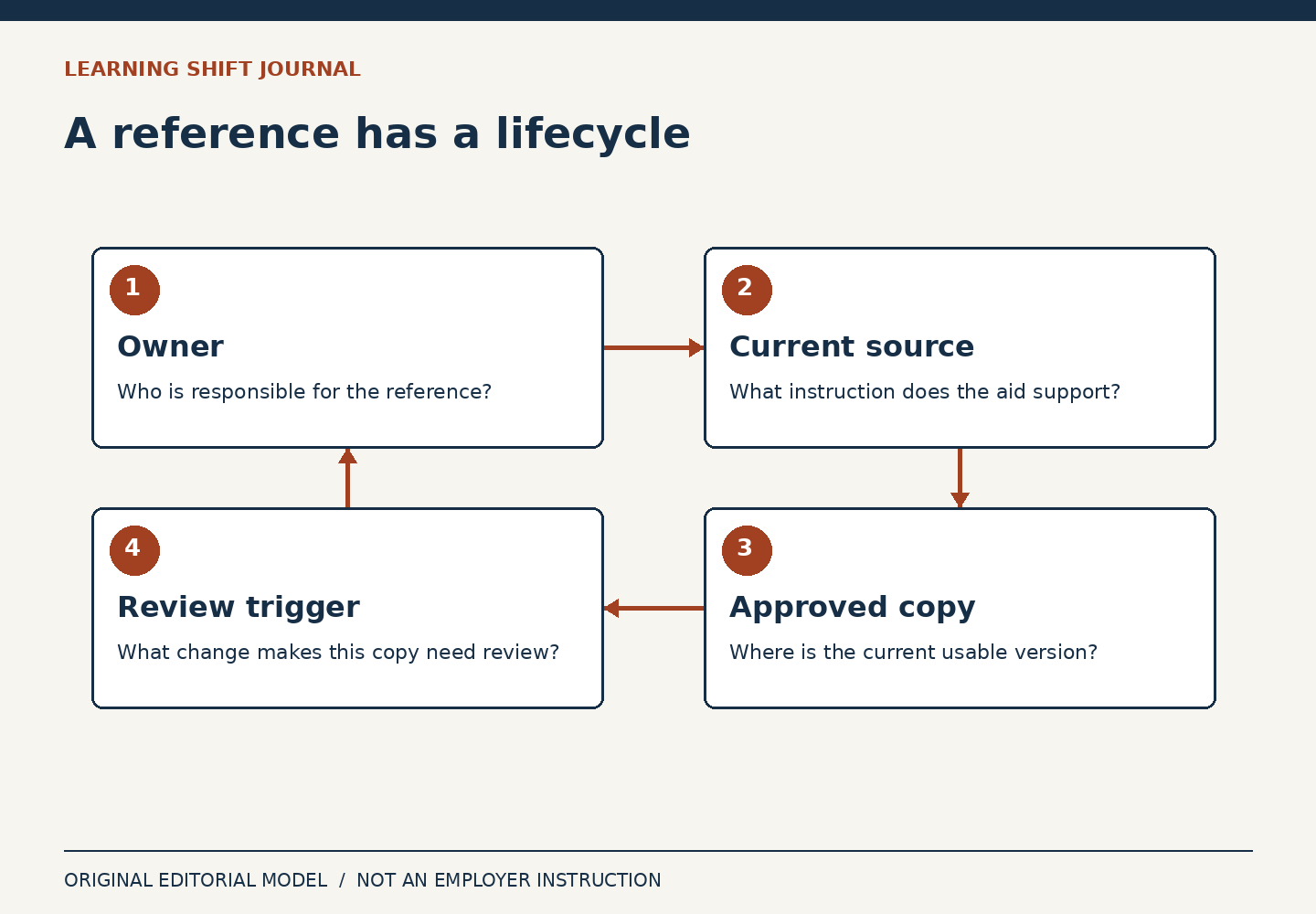
- Plan maintenance before distribution Ask who can replace it, where the current copy lives and what happens to older copies. A date alone is not a maintenance plan. A six-month-old aid may still be valid, while yesterday's copy may already be wrong. Record the condition that triggers review, such as a changed workflow or source, and follow the department's document-control process.
- Sources and scope
A short reference can save attention at a busy desk. It can also preserve an old instruction long after the process has changed. For a Northwell nonclinical team, the hard part of a job aid is not fitting the words onto one page. It is making clear whose instruction it is, which task it supports and how someone knows it is still applicable.
Begin with the controlling source Use the employer-approved procedure or reference for the actual task. A public careers page describes types of work, not the local steps for completing it. AHRQ's plain-language resource can help you notice unnecessarily complex wording, but it does not authorize changing the meaning of a workplace instruction.
Write the intended audience and task in plain terms. “Visitor desk: locating an approved destination” is more useful than “Important information.” Include the source owner and version information the employer requires. If you are proposing a new aid, label it as a draft for review and keep it out of circulation until the responsible person approves it.
Make the stop point visible A good aid does not pretend to cover every exception. It should indicate when to use the designated escalation route: an absent destination, conflicting instructions, a request outside your role or a situation requiring clinical judgment. The escalation information itself must be current and approved.
Imagine a fictional map card that lists a clinic in one building but omits that the entrance changes after certain hours. The failure is not simply missing detail. The card invites the reader to assume that one route applies all day. A better review asks whether the source describes time-dependent conditions and how the desk confirms them.
Test the reader's path Ask an authorized colleague to use a fictional scenario and describe what they would do first. Do they find the task, the necessary condition and the stopping boundary? Do they mistake an example for a rule? Review the wording before adding more decoration. A large warning cannot compensate for an ambiguous instruction.
Avoid unofficial logos or visual styling that makes a draft look like a Northwell policy. Keep private system screenshots out unless the employer permits them and the approved process handles the information safely. The aid should support the official source, not become a parallel authority.
Plan maintenance before distribution Ask who can replace it, where the current copy lives and what happens to older copies. A date alone is not a maintenance plan. A six-month-old aid may still be valid, while yesterday's copy may already be wrong. Record the condition that triggers review, such as a changed workflow or source, and follow the department's document-control process.
Sources and scope
Public sources checked October 5, 2026. Dated accounts remain historical; examples and planning methods in this article are original editorial constructions.
- AHRQ: Plain Language Words
Examples of everyday vocabulary; editorial job-aid exercises are original and not official Northwell materials.
- Northwell: Non-clinical careers
Public context for the breadth of nonclinical work; no current vacancy, employment term or assignment is promised.